Showing posts with label Trips Away. Show all posts

Monday, December 31, 2018

Bulwer away-trip, 26-30 November 2018 including Ashtonvale, Hela Hela, Highover, Sani Pass


Total Species identified: 102
Script: Hazel van Rooyen
Jackal Buzzard (photo Stan Culley)

Participants: Barrie Willis & Sue Hansbury, Stan & Val Culley, Graham & Sue Salthouse, Stanley & Asothie Gengan, Vic & Kay Neilson, and Bob & Hazel van Rooyen


View from Ashtonvale (photo: HvR)

A motley crew! (photo Sue Salthouse)


Red-chested Cuckoo (photo Stan Culley)


At the end of November 2018, 12 club members visited Ashtonvale Guest Farm for our Spring trip away.  On arrival, a pair of friendly Familiar Chats flitted in the garden of our house and became a “familiar” sight during our stay.  A small herd of cows and some donkeys grazed in the field next to us adding to the sense of peace of the rural scene of rolling hills and forestry.  The weather was threatening rain and so we contented ourselves with settling in and exploring the property and found a lovely place to braai on the garden patio which was next to an enclosed patio where we made ourselves comfortable each evening around a table tennis table to eat our supper.  Later we discovered a dining room but nobody seemed to mind our choice of eating-place!  Other birds seen on our way in and round about the farm were a Long-crested Eagle, Jackal Buzzard and Barn Swallows, amongst others (see list at end).

On Tuesday we added Speckled Mousebird, White-rumped Swift and a Red-chested Cuckoo which called incessantly from a forest across the field.  A 6am start found us en route to Hela Hela. 
View from Hela Hela
African Stonechat abounded on the telephone wires, while a Yellow-billed Kite and Jackal Buzzard graced the skies. 
Jackal Buzzard (photo: Stan Culley)


Cape Vulture (photo HvR)
Arriving at the farm gate a couple of Cape Vultures sailed curiously overhead.  We had called ahead to arrange a key from the Highover manager but a team of labourers were already busy moving recently logged trees.  Our target was the Black-rumped Buttonquail so we spread out to cover the grassland in the hope of flushing this special bird. 
Spread out to look for the Black-rumped Buttonquail
A slow walk of about 2 hours in 44 deg heat ensued, the only quails found being Common Quails.  We did disturb a Denham’s Bustard which was a nice sighting.  On returning to the vehicles, those who hadn’t managed more than 100 metres gleefully reported that the Black-rumped Buttonquail had flushed at their feet.  Some other species identified were African Black Swift, African Pipit, Rufous-naped Lark, Fan-tailed Widowbird, and Emerald Cuckoo.

Cape Batis (photo) HvR)

This was followed by a visit to Highover where we found a shady place to breakfast.  Green Wood-Hoopoe. Yellow-throated Woodland Warbler, Cape Batis, Bar-throated Apalis were noted, even though the bush was very very dry.  The accommodation looked quite run down which was a pity as we had enjoyed our previous stay so much.

On rising the next day our hopes for another early start dwindled as the heavy mist turned into rain.  We moved into the huge hotel lounge where the staff made us cosy with a roaring log fire as temperatures had dropped to 18 deg.  Barrie came to our rescue with a fun quiz – boys vs girls – which was won by the boys by half a point!  Around the hotel grounds we added Drakensburg Prinia, Hamerkop and Greater-striped Swallow and Ant-eating Chat to our Ashtonvale list
.
Ant-eating Chat (photo Stan Culley)

By this time it looked as if the weather was clearing so we took to our vehicles (doubling up as usual) and followed directions from Roberts to Comrie Dam.  We found an indentation that looked as if  it could have been a shallow dam sometime in the distant past but after travelling 15km over and above the 4km required, with no sign of water, we decided to turn around.  However, later on we thought we may have been hasty and should have continued along the dirt road.
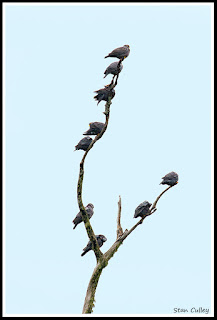
African Olive Pigeons (photo Stan Culley)


So we moved on to the Marutswa Forest & Boardwalk, searching for the Orange Ground Thrush and Cape Parrot.  Close to the entrance a flock of African Olive Pigeons perched on a tall dead tree. The forest was lovely, wild gloxinias flowered at the foot of massive trees.  The boardwalks had sadly been trashed and some attractive, fairly new reception rooms at the entrance had been vandalised.  Very sad, what a waste.  Birdlife was scarce but we did at least hear the Orange Ground Thrush calling several times quite close by.  No sign of the Cape Parrot but Russell Hills, our host at Ashtonvale brought some of us up the next afternoon just before sunset to see them as they usually roost there.  He had recently taken an overseas film crew there with success. However, still no sign, maybe we left a little early – later I read the roosting times can be extended during misty weather.  Other birds heard in the forest were Sombre Greenbul, Knysna Turaco and Green-backed Cameroptera.  Stan also saw an African Harrier Hawk.

Brown-throated Martin (photo Hazel van Rooyen)
Streaky-headed Seedeater (photo Hazel van Rooyen)


On Thursday we took a drive around the area and part-way up the Sani Pass.  We crossed a pretty river called the Polelwa, over which Brown-throated Martin and White-throated Swallows swooped.  Further on we spotted a Streaky-headed Seedeater, Levaillant’s Cisticola and a Red-necked Spurfowl, a Lifer for some.  
Red-necked Spurfowl (photo Stan Culley)
Giant Kingfisher (photo Hazel van Rooyen)

Lake near Himeville (photo Hazel van Rooyen)

It was lovely to see Vic & Kay Neilson who are well and enjoying their retirement in Himeville, they joined in all the activities and send their kind regards to all the members they used to know.   Close to Himeville Vic & Kay took us to a pretty lake surrounded by exotic parkland, which was privately owned and maintained but open to the public.  Here we saw Little Grebe, Reed Cormorant, Common Moorhen, Giant Kingfisher, Red-knobbed Coot, and Brown-hooded Kingfisher.

When we reached the base of the Sani Pass we stopped off at the Giant Teacup where Vic arranged for us to trek up one of their trails.  Here we saw the Ground Woodpecker and Long-crested Eagle and around the tearoom were Olive Thrush, Drakensburg Prinia and Greater Double-collared Sunbird.

At Sani Pass major road works are happening and the going is very very slow.  Halfway up we pulled off for some lunch.  The scenery was amazing and the birdlife was good, especially considering the upheaval going on around. 
View of Sani Pass
Yellow Bishop (photo Hazel van Rooyen)


Gurney's Sugarbird (photo Stan Culley)
Cape Canary (photo Hazel van Rooyen)

Yellow Bishop, Gurney’s Sugarbird, Cape Canary, Red-collared Widowbird and Buff-streaked Chat kept us entertained.  On the drive back we passed a dam, close to Okhalweni Railway Station where we added Cape Shoveller, Black-winged Stilt, Whiskered Tern, Ruff, African Spoonbill, Shelduck, amongst others.

The owners of Ashtonvale Guest Farm, Russell and Carol Hills made us very welcome and if the accommodation stretched our imagination, the great company made up for it.  Thanks go to Russell and Carol for accommodating us and making us feel at home.  They have a great family holiday establishment with lots of animals including a friendly pot-bellied pig, milking cows, croquet, bowls, tennis and table tennis, a tiny chapel for weddings, plus a lovely swimming pool which cooled the writer down on the hottest of days.

Thanks again to one and all for another great trip.
Common (Steppe) Buzzard (photo Stan Culley)

 All photos copyright of photographer

Species identified: Apalis, Bar-throated; Barbet, Black-collared; Batis, Cape; Bishop, Southern Red; Bishop, Yellow; Bokmakierie; Boubou, Southern; Bulbul, Black-capped; Bustard, Denham’s; Buttonquail, Black-rumped; Buzzard, Common; Buzzard, Jackal; Cameroptera, Green-backed; Canary, Cape; Canary, Yellow-fronted; Chat, Ant-eating; Chat, Buff-streaked; Chat, Familiar; Cisticola, Levaillant’s ; Coot, Red-knobbed; Cormorant, Reed; Crane, Blue; Crane, Grey-crowned; Crow, Cape; Cuckoo, Black; Cuckoo, Emerald; Cuckoo, Red-chested; Darter, African; Drongo, Fork-tailed; Duck, Yellow-billed; Eagle, African Fish; Eagle, Crowned; Eagle, Long-crested; Egret, Great; Egret, Little; Fiscal, Common; Flycatcher, Dusky; Flycatcher, Paradise; Flycatcher, Southern Black; Goose, Egyptian; Grebe, Little; Greenbul, Sombre; Guineafowl, Helmeted; Hamerkop; Hawk, African Harrier; Heron, Black-headed; Ibis, Sacred (Polela River); Kingfisher, Brown-hooded; Kingfisher, Giant; Kite, Yellow-billed; Lapwing, Blacksmith; Lapwing, Wattled; Lark, Rufous-naped; Martin, Banded; Martin, Brown-throated; Moorhen, Common; Oriole, Black-headed; Pigeon, African Olive; Pipit, African; Prinia, Drakensburg; Prinia, Tawny-flanked; Puffback, Black-backed; Quelea, Red-billed; Raven, White-necked; Robin-Chat, Cape; Ruff; Seedeater, Streaky-headed; Shelduck; Shoveller, Cape; Sparrow, House; Spoonbill, African; Spurfowl, Red-necked; Starling, European; Stilt, Black-winged; Stonechat, African; Stork, White; Sugarbird, Gurney’s; Sunbird, Collared; Sunbird, Greater Double-collared; Sunbird, Olive; Sunbird, Southern Double-collared; Swallow, Greater-striped; Swallow, White-throated; Swift, African Black; Teal, Red-billed; Tern, Whiskered; Thrush, Olive; Thrush, Orange Ground; Turaco, Knysna; Vulture, Cape; Wagtail, Cape; Warbler, Yellow-throated Woodland; Waxbill, Common; Weaver, Cape; White-eye, Cape; Whydah, Pin-tailed; Widowbird, Fan-tailed; Widowbird, Long-tailed; Widowbird, Red-collared; Wood-hoopoe, Green; Woodpecker, Ground; Woodpecker, Olive.

Monday, March 19, 2018

AWAY TRIP REPORT: ST LUCIA - 19-23 MARCH 2018


Participants: Sandy Olver, Margaret Jones, Doug & Angie Butcher, Stanley & Asothie Gengan, Barrie Willis & Sue Hansbury, Graham & Sue Salthouse, Stan & Val Culley, Robin Eccles, Bob & Hazel van Rooyen 

Species: 132                                                                             Text: Hazel van Rooyen


Monday:  Arriving at St Lucia Wilds more or less all at the same time, we scuttled about off-loading luggage and quickly got settled in so that we could suss out our surroundings.  Livingston’s Turaco and Yellow-rumped Tinkerbird competed for The Voice.  We then visited the ski-boat club where the verandah overlooked the estuary.  On the opposite side a Goliath Heron stood in the shallows along with Pink-backed Pelican, Grey Heron and Black-winged Stilts, amongst others.  Taking the popular boardwalk brought us closer to more waders – African Spoonbill, Little Egret, Ruff, Whimbrel and White-winged Terns.  
Pink-backed Pelican (photo HvR)

An African Pipit skittered about the sand dunes (photo HvR)


An immature African Fish Eagle hunted over the estuary (photo HvR


A Spotted Flyctacher at our accommodation (photo HvR)

Tuesday:  In the morning we got an early start into Isimangaliso Wetland Park but Crested Guineafowl were even earlier, rushing hither and thither (as they do) around the grassy area outside our chalets.  Once in the park, White-eared and Black-collared Barbets were very visible and soon Amethyst and Scarlet-chested Sunbirds along with Blue-cheeked Bee-eaters were showing off their iridescent plumage. 
Scarlet-chested Sunbird (photo HvR)

Blue-cheeked Bee-eater (photo HvR)

Amongst all the activity, a Diederik’s Cuckoo caught a juicy caterpillar (photo HvR


Woolly-necked Stork (photo HvR)
The water had receded greatly since our last visit but following a loop we came to iZindondwe Pan which at first glance looked deserted but on closer inspection we picked up a Wood Sandpiper, African Jacana, Black Crake on the periphery while a Woolly-necked Stork peeped out of the tall sedges.  A Black-chested Snake Eagle soared regally above us.  Moving along, a family of Amur Falcons looked settled in a leafless tree and a few minutes later we drove passed a Brown Snake Eagle perched in another tree.

Amur Falcons (photo Stan Culley)
Amur Falcon Male (photo HvR)


Amur Falcon Female (photo HvR)

Black-chested Snake Eagle (photo Stan Culley)

Bushbuck (photo HvR)
Breakfast had been planned for the hide at Mfazana Pan but the water was so far away we decided to picnic at Mission Rocks beneath the shady thorn trees.  Bushbuck and Duiker foraged creating an idyllic atmosphere. 
Relaxing at Mission Rocks (photo DB)

Breakfast in a shady spot (photo Doug Butcher))

Breakfast (photo Doug Butcher)


At Catalina Bay we stopped to enjoy the view.  A pair of Buffalo stood drowsily cooling off in the lake.  Bliss!
Buffalo enjoying a cool siesta (photo HvR)


Brown Scrub-Robin (photo Stan Culley)


Moving on to Cape Vidal, Cape & Pied Wagtail were busy amongst the holiday makers and a shy Brown Scrub Robin caught Stan’s sharp eyes.  Driving back slowly via the Red dunes, Senegal Lapwing posed obligingly and a single Red-backed Shrike balanced on the telephone wires.  
Senegal Lapwing (photo Stan Culley)
Red-backed Shrike (photo HvR)

View from Mission Rocks (photo HvR)
A herd of Buffalo gazed lazily at us, chewing their cud and letting Red-billed Oxpeckers groom them.
Red-billed Oxpeckers (photo HvR)

Red-billed Oxpeckers (photo Doug Butcher)


Later in the afternoon Stanley & Asothie, Bob and I took a walk in the iGwalagwala Forest which was next to our accommodation.  We were looking for the African Broadbill which we actually found -  hoorah! (Unfortunately no photo)

Assassin Bugs (photo HvR).

Assassin Bugs, in camouflage outfits, enjoyed an orange-coloured fruit.  It was very humid after a very hot day and going round in circles, we almost got lost.  We had just found the road when Barrie & Sue drove by on their way to the ski-boat club for drinks. 

Thankfully he offered us a lift back and we all managed to get into his spacious new car.


Yellow-breasted Apalis (photo HvR)
Rudd's Apalis (photo HvR)


Wednesday morning dawned sunny and breezy and the whole group gathered for another walk in the Forest.  Black-backed Puffback and Square-tailed Drongo chortled and whistled and a Dark-backed Weaver performed somersaults in his immaculate yellow and black suit, swinging upside-down looking for tasty grubs.  We were eyeing up several small birds flitting in the thicket when we realised one was the Woodward’s Batis.  How thrilled were we!  Another Lifer for most of us.  The Rudd’s Apalis was another of the little darting birds along with Yellow-breasted Apalis.
   
Golden-tailed Woodpecker (photo HvR)

A Golden-tailed Woodpecker squawked loudly and a Crowned Hornbill came to see greet us.  Then we espied a pair of Yellow-bellied Greenbulls feeding two hungry chicks on a nest.  That was very special.  

 Yellow-bellied Greenbull chick (photo Sue Salthouse)


In the open grassy area a beautiful Flame Tree was in full flower.
Natal Flame Tree (photo HvR)

Home then to breakfast, after which most of us set off for a trip up the Western Shores.  This was rather disappointing  as regards birdlife except for a large flock of Collared Pratincoles on the dirt road which kept flying up as the vehicles approached, only to land a few paces further on, and nearly always facing away from us. 
Collared Pratincole (photo HvR)

A Wattled Lapwing and Common Fiscal were also seen.  Arriving at the aerial boardwalk we were glad to have a snack break in a shady glade.  The short boardwalk was very pretty with lovely views at the end.  Intermediate Egrets were spotted and Barrie and Sue saw an African Marsh Harrier hunting over the reed beds.  A Terrestrial Brownbul complained crossly from the understory.
Aerial Boardwalk (photo HvR)

Aerial Boardwalk (photo HvR)


Lilac-breasted Roller (photo HvR)

Herd of Blou Wildebeest (photo HvR)
Lilac-breasted Roller (photo Stan Culley)
In the meantime the Butcher party off four had caught up with us.  They had cleverly followed the one way detour and had seen Banded Martin and Martial Eagle, plus a single elephant.  
Martial Eagle (photo Doug Butcher)

Pied Crow (photo Doug Butcher)
Driving back the heat was intense and the only birds seen were African Pipit and European Roller.  A herd of Blou Wildebeest lazily looked on, such a quintessential sight of the African bushveld.

On Thursday morning, our last day, we breakfasted first then ventured onto the beach dune walk, managing to see Curlew Sandpiper, White-fronted and Grey Plovers plus Little Stint but then the rain came down and we rushed for shelter beneath some bushes.  It soon stopped and only a bit damp,  some of us ventured further on but soon it started up again and eventually we had to give in and went home, wet tails between our legs, to get into dry clothes.
African Jacana, Juv (photo HvR)

Wood Sandpiper (photo HvR)

Common Ringed Plover (photo HvR)
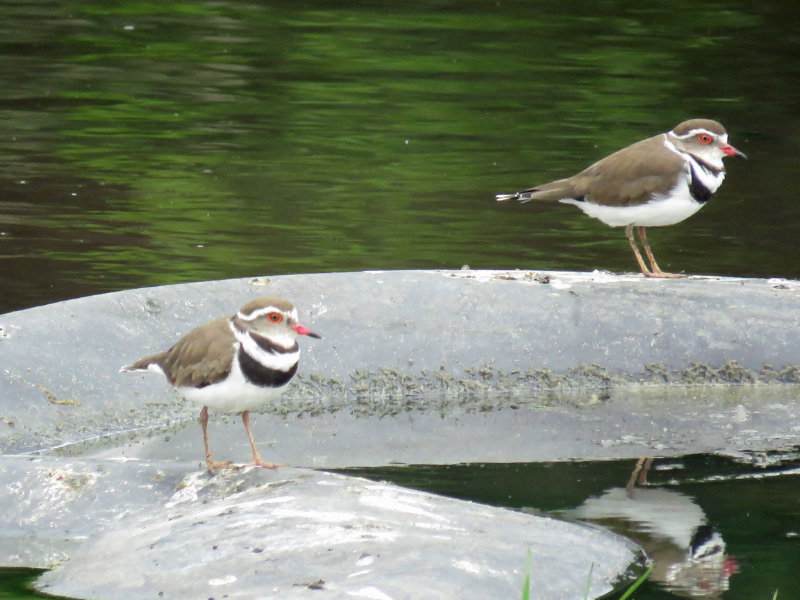
Undeterred, the Ponds were our next port of call, brave souls that we are! (It was a bit stinky).  An immature African Jacana, a company of White-faced Ducks, 3-banded Plover, Wood Sandpiper and Common Ringed Plover  were seen while White-faced Bee-eaters graced the air and Wire-tailed Swallows congregated on dead sticks in the middle of the pond.
Wire-tailed Swallows (photo HvR)
3-banded Plovers (photo Doug Butcher)

Then, taking a risk with the weather, some of us decided to give the estuary beach another chance.  This was worth the effort, adding several species to our list – Swift Tern, Grey-headed Gull, Water Thickknee, and Lesser-crested Tern.  We had a long return walk - all of two km’s but heavy going across the sand (especially for Stan with his scope) and eventually we called it a day and returned to those waiting patiently in the cars.  
Top R: Swift Tern/ Middle L: Lesser Crested Tern (photo HvR)

Swift Terns (photo HvR)

Grey-headed Gull (photo HvR)

Intrepid bird watchers (photo HvR)
Water Thick-knee (photo HvR)

Caspian Terns (photo HvR)

Curlew Sandpipers, transitioning into breeding plumage (photo HvR)

As we got home the rain started in earnest and didn’t let up till the following morning when we had to leave anyway.  The guys still managed to braai and they must be thanked for cooking for us every night.  Also thanks to Imelda and her team at St Lucia Wilds for making us so at home.  The units lacked for nothing and everything worked!  The swimming pool was most welcome too.  We didn’t see the hippo which sometimes takes a short cut through their property but Sue & Barrie encountered him (or her) on the street on their way to their accommodation one dark and lonely night - must have been a shock.  

Thanks to all participants and helped make the trip so pleasant and share their vast knowledge, especially Stan Culley. Everyone agreed that it was a successful trip.  Stan commented that overall some species were conspicuous by their absence, such as flycatchers, mannikins and waxbills.  Graham must have got the most Lifers – at least 19-plenty!  He still didn’t get his “Tufted" Flufftail (and mostly likely never will) but he gave us a lot of laughs.  I wonder what our next trip holds.
Curlew Sandpipers take off (photo HvR)

A swirl of Sandpipers (photo HvR)


Searching ... searching (photo Doug Butcher)

Visibility was poor (photo Doug Butcher)

Straggling along (photo HvR)
Drinks at the ski-boat club (photo by waiter)


4 Caspian Terns & 1 Swift Tern (photo Doug Butcher)

Bird List
Apalis, Rudd’s
Apalis, Yellow-breasted
Barbet, Black-collared
Barbet, Crested
Barbet, White-eared
Batis, Woodwards
Bee-eater, Blue-cheeked
Bee-eater, European
Bee-eater, Little
Bee-eater, White-fronted
Boubou, Southern
Broadbill, African
Brownbull, Terrestrial
Bulbul, Dark-capped
Bush-shrike, Gorgeous
Bush-shrike, Orange-breasted
Cameroptera, Green-backed
Canary, Brimstone
Canary, Yellow-fronted
Cisticola, Croaking
Cisticola, Rattling
Cisticola, Zitting
Cormorant, Reed
Cormorant, White-breasted
Coucal, Burchell’s
Crake, Black
Cuckoo, Diederick’s
Cuckoo, Klaas’s
Cuckooshrike, Grey
Dove, Emerald-spotted
Dove, Red-eyed
Drongo, Fork-tailed
Drongo, Square-tailed
Duck, White-faced
Duck, Yellow-billed
Eagle, African Fish
Eagle, Black-chested Snake
Eagle, Brown,
Eagle, Martial
Egret, Intermediate
Egret, Little
Falcon, Amur
Fiscal, Common
Fly-catcher, Spotted


Goose, Egyptian
Goose, Spurwing
Greenbul, Sombre
Greenbul, Yellow-bellied
Guineafowl, Crested
Guineafowl, Helmeted
Gull, Common
Gull, Grey-headed
Harrier, African Marsh
Hawk, African Harrier
Heron, Goliath
Heron, Grey
Heron, Purple
Honeyguide, Greater
Hornbill, Crowned
Hornbill, Trumpeter
Ibis, Hadedah
Jacana, African
Kingfisher, Brown-hooded
Kingfisher, Pygmy
Lapwing, Blacksmith
Lapwing, Senegal
Lapwing, Wattled
Longclaw, Yellow-throated
Martin, Banded
Martin, Sand
Oxpecker, Red-billed
Pelican, Pink-backed
Pipit, African
Plover, 3-banded
Plover, Common Ringed
Plover, Grey
Plover, Kitlitz
Plover, White-fronted
Pratincole, Collared
Prinia, Tawny-flanked
Puffback, Black-backed
Robin, Brown Scrub
Robin-Chat, Red-capped
Roller, European
Ruff
Sanderling
Sandpiper, Curlew
Sandpiper, Wood


Saw-wing, Black
Shrike, Red-backed Shrike
Sparrow, Grey-headed
Sparrow, House
Spoonbill, African
Starling, Black-bellied
Stilt, Black-winged
Stint, Little
Stork, Saddle-billed
Stork, Woolly-necked
Sunbird, Amethyst (M&F)
Sunbird, Collared
Sunbird, Grey
Sunbird, Olive
Sunbird, Purple-banded
Sunbird, Scarlet-chested
Swallow, Barn
Swallow, Wire-tailed
Swamphen, African
Swift, African Palm
Swift, Common
Swift, Little
Swift, White-rumped
Teal, Red-billed
Tern, Caspian
Tern, Common
Tern, Lesser-crested
Tern, Little
Tern, Sandwich
Tern, White-winged (black)
Thickknee, Water
Tinkerbird, Yellow-rumped
Turaco, Livingston’s
Turaco, Purple-crested
Wagtail, Cape
Wagtail, Pied
Weaver, Dark-backed
Weaver, Spectacled
Weaver, Thick-billed
Whimbrel, Common
Whydah, Pin-tailed
Woodpecker, Golden-tailed


All photos property of photographers

UPCOMING OUTING: Oribi Gorge Nature Reserve - 13 January 2019

Bar-throated Apalis Dear Members Sunday 13 January 6.30am BirdLife Trogons will visit Oribi Gorge Nature Reserve.  An entrance fee of R30 pe...